Monday, October 15, 2012

Shosei-en (bonsai nursery), Kyoto

Shosei-en was second of the two bonsai nurseries I visited in Kyoto. It should not be confused with the Shosei-en garden located in the vicinity of Kyoto Station. The nursery is tucked in a residential area and a bit tricky to find. However, it is only a ten minute walk from Misasagi Station (Tozai Line) and if you walked longer than that, you are probably lost. The entrance to the nursery is fairly nondescript with the exception of a small name board (image below left). Once you walk up to the gate at the end of a long driveway you can see the shelves with bonsai (image below right). At the time of my visit the nursery was minded by an elderly lady who I thick was one of the owners. My Japanese allowed me to have only a rudimentary conversation with her, so I just had a stroll around the nursery and took some photos.


Unlike Koju-en, Shosei-en is larger and specialises in medium to large trees. It did have few shohin bonsai however. Both coniferous and broadleaved trees were equally well represented (images below).


Among conifers pines were the most prominent trees and images below may give you an idea of their quality.


Conifers other than pines dotted the shelves of the nursery. Images below show Cryptomeria, Podocarpus and junipers.


Broadleaved trees were dominated by Japanese and Trident Maples. I couldn’t see the branch structure of the trees very well because they were in full leaf, but many of them had nice proportions and some featured fantastic surface roots (see images below).


Finally, few images of shohin trees are shown below. I thought some of them were quite good.


The choice of bonsai pots at Shosei-en was somewhat limited, but overall I had a good time there.


For posts about bonsai gardens I visited in China see these:
Tiger Hill Penjing Garden, Suzhou: http://lomov.blogspot.com.au/2015/01/tiger-hill-penjing-garden-suzhou.html
Penjing Garden at Shanghai Botanic Gardens: http://lomov.blogspot.com.au/2014/12/penjing-garden-at-shanghai-botanic.html
Penjing Garden at the Humble Administrator’s Garden, Suzhou: http://lomov.blogspot.com.au/2015/01/penjing-garden-at-humble-administrators.html

Sunday, October 14, 2012

Nijo Castle, Kyoto


I had limited time to see Nijo Castle and decided to focus on seeing its gardens. The parklands and the gardens of the castle exist in harmony with its buildings. The castle is surrounded by a water filled moat and a wall. Inside it has a fortified keep surrounded by a similar moat. The top row of images in the panel below shows the outer wall, while the bottom row shows the fortifications of the keep.


Nijo Castle’s gardens are situated between these two fortification lines. They provide scenic surroundings for the palace buildings. Images below show two of the most prominent buildings of the castle. Left image shows Ninomaru Palace and right image shows Honmaru Palace.


The buildings were impressive enough at a distance, but a closer look reveals exquisite detail too. Image below left shows a carved wooden panel above the Kurumayose entrance to Nimomaru Palace and image below right shows beautiful timber on the exterior of Honmaru Palace.


I already mentioned that castle buildings are well integrated into the parkland. Ninomaru Place is a good example of that. Images below illustrate how well it looks among the trees.


Nijo Castle houses two gardens of note. Both feature a pond with lots of rocks. One of them is Ninomaru Garden designed by tea master Kobori Enshu (images below).

The other garden is called Seiryū-en and it has been constructed only in 1965. It features two tea houses which are partially seen in the images below. Unfortunately, the tea houses were closed to public.


Most of the Nijo Castle grounds however are covered by parkland consisting of well-tended trees, shrubs and lawns. The park designer used lawns to create expanses of negative space, which frame trees and shrubs in a very pleasing way (see images below). This effect makes the landscape look bigger than it is.


I would definitely go to Nijo Castle again, especially because I haven’t seen the inside of its palaces. It must be spectacular during cherry blossom, the turn of maple leaves or in snow and would make it a completely different experience.

Noh and Kyogen at Kongo Nohgakudo


Seeing Noh performance at Kongo Nohgakudo theater was one of the main highlights of my stay in Kyoto. Images above show the theater building and the stage. Photography during the performance was prohibited. Getting tickets was easy. The programme was in Japanese, so I asked the box office lady to write down the play name in romaji. This allowed me to google it. The name of the Noh play was Ataka, and to my surprise, I was familiar with the story and its background. The play was about one of the incidents in a tragic conflict between two brothers Yoshitsune and Yoritomo in the 12th century Japan. One thing about the performance surprised me. The part of Yoshitsune, a seasoned military commander and an accomplished swordsman, was played by a boy of about thirteen. I knew that Noh can be a bit abstract, but didn’t expect adult parts to be played by children. The Noh performance was preceded by a Kyogen skit titled Inaba-do, which was truly funny. I immensely enjoyed both Noh and Kyogen.

So far, I have seen a few traditional Japanese performing arts. They are Noh, Bunraku (http://lomov.blogspot.com.au/2010/02/bunraku.html), Kabuki (http://lomov.blogspot.com.au/2010/02/kabuki-za.html), Kyogen and Kamishibai (http://lomov.blogspot.com.au/2010/03/kamishibai.html). I can draw parallels between them and I must say that Noh and Bunraku are my favorites.

Koju-en, Kyoto


Koju-en is a better known of the two bonsai nurseries in Kyoto. Finding it is easy, just a ten-minute walk from Nishioji train station on JR Kyoto Line. Image above shows the street view of its front gate. It is relatively small and two images below show most of its outdoor area.


I was shown around the nursery by the owner Tomohiro Masumi, who speaks passable English. He told me that the annual bonsai exhibition called Koju-ten organised by the nursery was going to be held next week. There were a few people preparing their trees for the exhibition and he pointed out the trees that were going to be exhibited. I also met Tomohiro’s father Hiroichi Masumi who started Koju-en in 1997. He was kind enough to give me an All Japan Shohin Bonsai Association wall calendar.

Koju-en specialies only in small bonsai (shohin bonsai). Both coniferous and broad-leaved plants were equally well represented. Images below show shelves with some of the top sellers (top to bottom left to right): Cotoneaster, Shimpaku Juniper, Japanese Maple, Trident Maple, pine and Hinoki Cypress.


For a closer look at some of the shohin trees at Koju-en see images below.
   

There were also a few admirable trees, which could qualify as medium size bonsai (see images below).


Koju-en featured a fine selection of antique, vintage and contemporary shohin bonsai pots from Japan and China (see images of the showroom below). Tomohiro showed me some of them and I ended up buying a pot by Kyoto-based potter Takao Koyo (to see the pot visit http://lomov.blogspot.com.au/2012/10/bonsai-pots-from-kyoto.html).


If you are a bonsai enthusiast stranded in Kyoto, Koju-en is worth a visit.

For posts about bonsai gardens I visited in China see these:
Tiger Hill Penjing Garden, Suzhou: http://lomov.blogspot.com.au/2015/01/tiger-hill-penjing-garden-suzhou.html
Penjing Garden at Shanghai Botanic Gardens: http://lomov.blogspot.com.au/2014/12/penjing-garden-at-shanghai-botanic.html
Penjing Garden at the Humble Administrator’s Garden, Suzhou: http://lomov.blogspot.com.au/2015/01/penjing-garden-at-humble-administrators.html

Saturday, October 13, 2012

Tofuku-ji, Kyoto


As you approach Tofuku-ji temple, the Tsuten-kyō bridge is the first structure you see (image above left). Walking on it reminded me one of those forest canopy walks, except that the walkway is done in medieval Japanese style (images above).
Tofuku-ji is the main temple of the Rinzai sect and it has some impressive buildings. On entering the gate (image below center) you see the Main Hall or Hon-dō (image below left). It’s quite imposing, but elegant too.

Another imposing structure is Tōfuku-ji's main gate, the oldest of its kind in Japan (images below). There is a very old juniper between the Main Hall and the main gate (image below right). I wish I could read the explanation plate about this tree, unfortunately it was only in Japanese (for a story about junipers at Kencho-ji temple in Kamakura see my blog entry at http://lomov.blogspot.com.au/2010/04/when-i-visited-kencho-ji-temple-in.html).

Other buildings I saw included priests’ living quarters or Kuri (image below right) and the Abbot’s Hall or Hōjō (image below left).

The original Hōjō building dates back to the 13th century, while its current version was built in 1890. However, the main attraction here is not the old building, but its four gardens designed by a scholar and garden designer Shigemori Mirei in 1939. At that time these gardens were perceived as a radical deviation from the tradition. The Southern Garden (images below) is the largest of the four. Its rocks symbolise four mythical islands, where each island is suggested by a group of rocks. The white sand represents “eight rough seas”, while mossy knolls at the far end of the garden signify “five sacred mountains”.

In the Eastern Garden Shigemori Mirei arranged seven old building foundation stones in the shape of the Great Bear constellation (images below).

The Northern Garden is just a moss field with square stones arranged like a gradually disintegrating checkerboard (images below). To me, this gradient from regular to random is another way of saying “nothing is perfect”. The checkerboard pattern is unusual for Japanese gardens, but I’ve seen it in the interior decoration of traditional houses (see rightmost image below).

The checkerboard theme continues in the Western Garden (images below). Although this garden is Japanese in its essence, it shares many similarities with the French Formal Garden. Here, trimmed azaleas, moss turf and decorative gravel can be viewed as a variation of parterre de gazon of the French garden.

After that, I went to see the garden of Kaizan-dō Hall. This garden is divided by a central path (leftmost image below). The two sides of the garden created by this path stand in sharp contrast to each-other. One side is a field of white sand raked in a checkerboard pattern (panel below, third image from the left). This part of the garden is framed by the building. The only irregularity in the perfect geometric order of this side is a single mossy island with a beautiful tree growing among the rocks (rightmost image below).

The other side of the garden is a very textural juxtaposition of moss, button-shaped azaleas, water and rocks (see images below). It has a beautiful backdrop of tall trees (panel above, second image from the left).

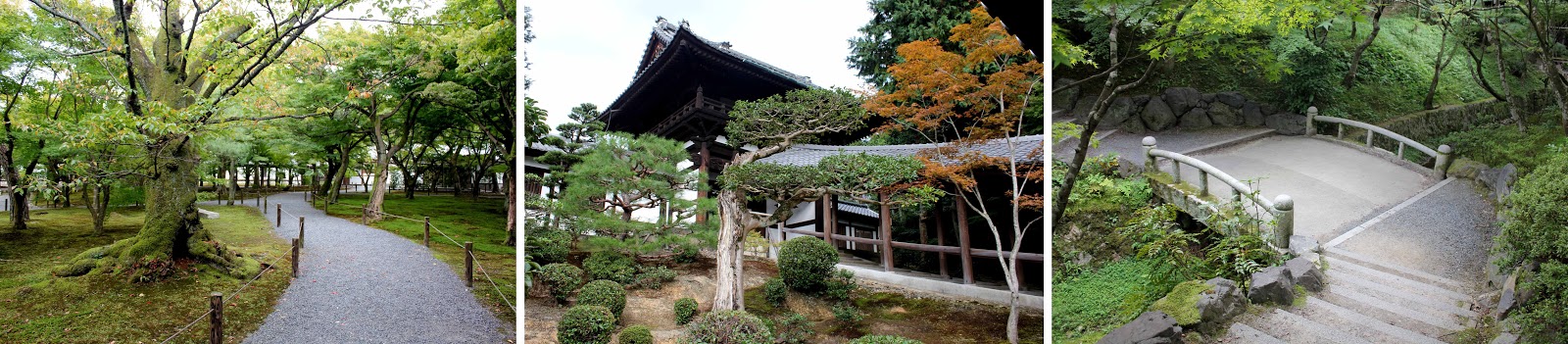
The temple’s grounds also have lots of parkland some of which is quite scenic (see images below).

My visit to Tofuku-ji offered me more than I expected. The only regret is that I missed out on seeing dry gardens of Reiun-in and Ryoginan-tōtei buildings. I guess it’s an incentive to visit this temple again.