Sunday, May 08, 2011

Bonsai Study Group Show


Yesterday, I saw exhibition of the Bonsai Study Group at West Pymble Community Hall. It was a relatively small show with the emphasis on small bonsai. For me, the highlight of the exhibition was Pat Kennedy’s bonsai pots stall. Bonsai in Australia may have a long way to go, however we already have high quality locally made bonsai pots. The photo of Chrysanthemum is just random.

Friday, May 06, 2011

New wood-fired pots


A couple of pots that came out from the last month’s wood-firing. This time I prepared the glazes myself. The pot on the left is 12.5 × 11 cm, unglazed with natural ash.The pot on the right is 16 × 7 cm, celadon glaze.


Thursday, April 14, 2011

Perth: Lee's Bonsai World vs. Miss Luong's Kitchen

Is it just me or there is a bit of a competition for advertising space here? And who painted the mural Miss Luong or Mr. Lee?


Saturday, April 09, 2011

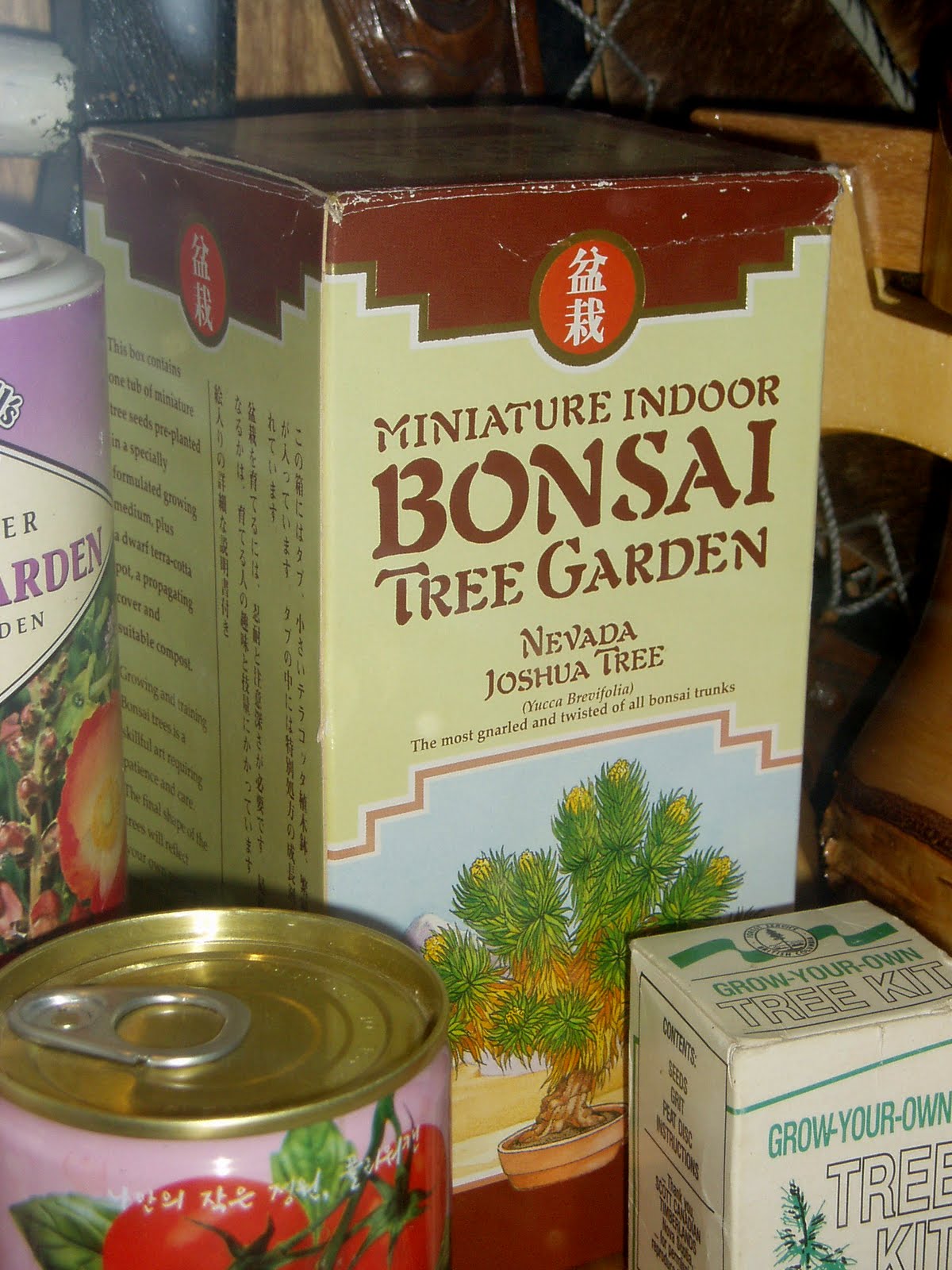
Worst possible introduction to Bonsai

I found it at last – the worst possible introduction to bonsai. It is an American product called “Miniature Indoor Bonsai Tree Garden”. I like it because it is wrong in so many different ways! It starts with a ridiculous name and then goes on to tells us that “This box contains one tub of miniature tree seeds pre-planted in a specifically formulated growing medium, plus a dwarf terracotta pot, a propagating cover and suitable compost.” So, that’s how it works!
...........................................................................................................


(MINIATURE TREE SEEDS) + (DWARF TERRACOTTA POT) = (MINIATURE INDOOR BONSAI TREE GARDEN)

Now that we are armed with the secret bonsai formula, how can we go wrong?

Sunday, April 03, 2011

Bonsai Show of Nepean Bonsai Society


Today, I saw the annual bonsai show of Nepean Bonsai Society held at Penrith PCYC. There were a couple of modest trees, but the display of miniature bonsai pots from the collection of John Marsh stole the show. The photographs say it all.


Saturday, April 02, 2011

Another pot


Last Christmas holidays, I missed playing with clay so much that one day I just sat and started hand-forming a small bonsai pot. It took long to get it fired, but the result is pleasing.

Wednesday, March 30, 2011

Mediocrity strikes back / New hope

Last Sunday, I visited the annual exhibition of the Bonsai Society of the Central Coast held at Gosford City Arts Centre. I’ve never been to their shows and this exhibition disappointed me. All trees were mediocre and uninspiring. Some trees were untidy and not properly prepared for the exhibition. Some trees exemplified bad horticultural practices. Some rather average trees were labeled as winners of past exhibitions, which indicated that the society rewards mediocrity.
To me the highlight of the visit was the Japanese garden outside the centre. It possesses a certain charm (see photos) and it has a tremendous potential for further refinement. The pavilion and the pond bridge are the star performers in the garden. It also features a nice tea-garden style arbour and a couple of decent stone lanterns. The most obvious area for improvement is the dry garden.

Friday, February 25, 2011

Termite factor

Last month, I visited Australian Northern Territory and was keen to see examples of naturally dwarfed plants in tropical savanna. It was a wet season, the time when many plants undergo a period of rampant growth. Very familiar young eucalypt trees boasted very unusual one-foot-long leaves. However, I did observe an unexpected natural force which can suppress plant growth even at this time of the year. Termites. The tree on the picture is stunted because it is virtually growing on a termite mound. Whenever any part of this tree dies due to heat, wind, insects, fungi, virus or bacteria it is immediately consumed by termites. I have a feeling that both the tree and the termite mound are quite old. From the trunk line we can see that its apex died back a few times and one of the side branches grew to be the new tree top.


Backyard clay

I had to dig a few holes in my backyard to put up a shade cloth frame over my bonsai shelves. The top soil layer was quite thin and underneath I found a very fine and pure brown clay. This is Wianamatta Shale clay characteristic to Sydney’s Cumberland Plain. I saved a small lump and used it to make a tea bowl shown in the picture. The shrinkage was nearly 30%, so the bowl turned out to be smaller than I expected. I fired it to earthenware temperature with clear glaze to preserve the original colour of the clay. The result was beautiful and quite similar to red raku ware (aka raku yaki). It also would have been not unlike the red clay ware (shudei) of Tokoname if it was burnished and not glazed.

Wednesday, February 16, 2011

The loveliest scenes of China

The most renowned Japanese poet Mitsuo Basho (1644-94) in his poem ‘The Unreal Dwelling’ extols a beautiful vista with pines and mountain wisteria and says: “I could not be but happy – the view would not have blushed before the loveliest scenes of China.” It suddenly struck me that by ‘the loveliest scenes of China’ Basho meant none other than the Huang Shan Mountains – the original inspiration for Chinese miniature landscapes and ultimately Japanese bonsai.

Thursday, January 27, 2011

Australia Day Bonsai Exhibition

Yesterday, I saw Australia Day Bonsai Exhibition organised for the first time and held at Merrylands RSL, Sydney. Members of eight New South Wales bonsai clubs put up their trees for the exhibition. This sort of show never happened in Australia before. A national exhibition like Kokufu-ten in Japan or the US National Bonsai Exhibirion is impossible in Australia due to bio-security regulations enforced by the federal government. However, Queensland, New South Wales, Victoria and Western Australia could hold their state exhibitions right now, but for some reason don’t. Anyway, the standard of Australia Day Exhibition was better than at usual individual club shows. Below are some trees. All Australian natives: 1- Port Jackson Fig (≈ 90 cm), Banksia (≈ 50 cm) and Baeckea (≈ 30 cm). Picture 4 shows a suiseki from China.


Saturday, January 22, 2011

Penching-like grapevine

Last winter I was visiting vineyards in Hunter Valley and was taken by the beauty of bare grapevine plants. They reminded me of the flat top penching trees characteristic of Yang School of Yangzhou. Some of them had amazing trunk movement with interesting dead wood like the one on the picture.

Monday, December 20, 2010

New tea bowl


A couple of weeks ago, I got a tea bowl which was thrown by Ian Jones, its foot was carved by me and then it was fired in Ian Jones’ anagama kiln. The tea bowl is alright, but I don’t get tired of saying that it was fired for 5 days with 20 tonnes of wood!

P. S. For more information about Ian Jones's studio see my blog post about it at http://lomov.blogspot.com.au/2010/08/during-recent-trip-to-canberra-with.html


Sunday, December 19, 2010

Tiny monster


Last month, I caught a 0.5 mm-long red mite on one of my fig bonsai. I assumed it is a pest and asked an expert to identify it. It turned out to be a predatory species Anystis baccarum which is actually beneficial to plants. It preys on plant eating mites. It’s amazing that just one bonsai tree can provide a whole universe for a tiny monster devouring plant pests we can’t even see. Unfortunately, the photograph of this mite mounted on a microscope slide doesn’t do it justice.

Sunday, November 21, 2010

First pot made on potter's wheel


This is the first ceramic object I made on potter's wheel. It was thrown in August, but glaze fired only last week. The decoration was totally random. First, I scribbled Lotus Sutra in Japanese and than drew a butterfly with a flower in the remaining surface.

Monday, November 15, 2010

Bonsai metaphor by Shoji Hamada

Shoji Hamada (1894-1978) was a famous Japanese potter who worked within Japanese folk art tradition. In 1974 an American art teacher Susan Peterson wrote a book about him where she transcribes her conversations with Hamada. In the following passage Shoji Hamada talks about traditional art and uses bonsai as a metaphor:
....................................................................................................................................................................


“In Mashiko and in Okinawa there are deep unconscious roots of tradition in the earth. For instance, compare dwarf trees in the garden and trees on the hill. If it’s a dwarf tree, when the weather gets a little bit bad you bring it in the house, if it gets dry you give it water. You trim the branches or not as you want. A traditional potter is like a dwarf tree. In the case of the [dwarf] tree you have to be careful about the weather, the other half depends on the care you give it. A tree in the mountains grows by itself. I should like to become such a tree.”

Saturday, November 13, 2010

Trasformation in a wood-fired kiln


Last year, I made a little mame / kusamono pot which was fired in an electric kiln and turned out to be quite uninteresting (left picture). I put it in the reject box and forgot about it. A couple of weeks ago, I looked though the box for pieces that could be re-fired in a wood-fired kiln. The picture on the right shows the same pot after it was wood-fired.

P.S. For more info on wood-fired kilns see: http://lomov.blogspot.com.au/2010/08/during-recent-trip-to-canberra-with.html

Pots thrown on a wheel


I am learning to make ceramics on potter’s wheel and these are first bonsai pots I threw on the wheel. The top picture shows a pot fired in an electric kiln and the bottom picture shows a pot with no glaze fired in a wood-fired kiln.

P. S. For a look at several wood-fired kilns see my blog post about them at http://lomov.blogspot.com.au/2010/08/during-recent-trip-to-canberra-with.html

Sunday, September 26, 2010

New Begining


................................................................................................................................. 
I finally got a new job!
It took 45 job applications
in a span of four years.
I hope it will invigorate
my scholarly and artistic pursuits.

Wednesday, September 01, 2010

Early history of bonsai in Russia

There were Russian settlements in China and Chinese settlements in Russia as early as late 17th century. By the end of the 19th century there were tens of thousands of Russians settled in various parts of China. Some of them were fluent in Mandarin and exposed to various aspects of Chinese culture including penjing. For example, we know of a Russian railway official Alexander Koreshov who resided with his family in a government house in Harbin, Manchuria around 1912. The house had a garden with a collection of penjing and a Chinese gardener who looked after it. These penjing trees made such a deep impression on Alexander Koreshov’s son Vitaliy that after settling in Australia he went on growing bonsai for the rest of his life. He became the founder of the first bonsai club and the first bonsai nursery in that country. ...............................................................................................................................................................
1956 - State Publishing of Agricultural Literature publishes a book titled ‘Indoor Gardening’ which contains a section titled ‘Dwarf Plants’. The section is written by G. E. Kiselev and presents a somewhat distorted view about ‘dwarf plants’. The section is accompanied by four images. One of them shows a 25-year-old Deodar trained in Literati style and planted in a shallow round container. The plant belonged to A. A. Karpenko from Sochi (presently Republic of Georgia).
..........................................................................................................................................................................
1960’s – An article about bonsai in a popular science magazine ‘Nauka i Zhizn’ (Science and Life). The article contained images of high standard Japanese bonsai and raised awareness about this art in the Soviet Union.
.....................................................................................................................................................................
By the end of the 60’s Anatoliy Annenkov, landscape architect at the Nikitsky Botanic Gardens, Crimea and Soviet Union’s leading landscape architect, develops considerable skills in growing and styling bonsai. He was a gifted artist and horticulturist who communicated with bonsai enthusiasts from other countries and used to make his own bonsai pots.
........................................................................................................................................................................
1976 – Japan presents Russia with a gift of 44 bonsai. The collection is housed in a subtropical glasshouse at the State Botanic Gardens of Academy of Sciences, Moscow. The curator of bonsai collection at that time is Tamara Belousova. This collection attracts a small group of bonsai enthusiasts which would form the core of bonsai community in Russia.
.......................................................................................................................................................................
1985 - Phyllis Argall’s book ‘Dwarf trees in the Japanese mode’ originally published in 1964 was translated and published in Russian. It was the first Russian language book which provided instructions for cultivating bonsai. It inspired many to take bonsai as a hobby.
........................................................................................................................................................................ 1988 – A group of bonsai enthusiasts who regularly met at the State Botanic Gardens in Moscow decides to form Russia’s first bonsai club.
......................................................................................................................................................................... 1989 – First bonsai exhibition held at the Japanese Garden of the State Botanic Gardens in Moscow.

Tuesday, August 31, 2010

Best wood-fired bonsai pot so far

I was really pleased with this wood-fired bonsai pot that came out of the kiln this month. It is probably this year’s best pot. It measures 27×23×7.5 cm. I am planning to replicate the success, but there is always an element of luck when it comes to wood firing.


P. S. For a look at several wood-fired kilns see my blog post about them at http://lomov.blogspot.com.au/2010/08/during-recent-trip-to-canberra-with.html

Wednesday, August 25, 2010

Root graft: Trident Maple

Easy as 1-2-3, but will the tree survive?


If the graft is successful the nebari should look better in 2 years.

P. S. To see what this tree was three years ago, when I bought it, see the following entry: http://lomov.blogspot.com.au/2007/10/natasha.html

Sunday, August 22, 2010

First try on a potter's wheel

Yesterday, I tried to use potter’s wheel for the first time. After working on it for four hours, left palm of my hand was bruised. At times, clay felt like sandpaper. After a few failed attempts, I have thrown two forms that later will become a coffee mug and a small round bonsai pot. The teacher was very encouraging. The picture below shows a beautiful Moreton Bay Fig I saw on the way to ceramics class.


Saturday, August 14, 2010

Japanese style wood-fired ceramic kilns


During a recent trip to Canberra with a group of potters I saw a number of Japanese style wood-fired kilns. Image below shows a two-chambered noburigama kiln at Sturt Pottery in Mittagong.


This pottery also has two anagama kilns. The image below left shows the longer anagama, while the image below right shows the front of the small anagama.


We also visited Old St Luke's Studio in Gundaroo owned by ceramic artist Ian Jones. He built a nine-meter-long anagama kiln shown in the image below left. This kiln is fired for five days and it takes twenty tonnes of pine wood. The other kiln at this studio is a one-chambered noburigama shown in the image below right.


Tuesday, August 10, 2010

My first Kokufu-ten album

I finally got my first Kokufu-ten album! Another “boring” coffee-table book avoided by the rest of my family. It is this year's issue No 84. A couple of observations I would like to share. First, the trees looked more interesting and impressive in real life. Second, the album allows a quick glance at the exhibition and enables us to see general trends. Many trees at Kokufu-ten exhibit ancient maturity and suggest an awe-inspiring length of time and the amount of labor it took to produce them. At the same time, such trees may lack artistic individuality. Look through the album and you will find trees that are almost identical to each-other. Is it a “bonsai copied from another bonsai” situation encouraged by the abundance of mass-produced advanced stock? I still love the book and keep going over my favorite trees.

Jeff Mincham's teabowls 2009

Last weekend,
I saw an exhibition
of ceramic art
by Jeff Mincham
at Watson Arts Centre
near Canberra.
I especially liked
this triptych
of teabowls:
1 - Morning Glory,
2 - Bitter Winds,
3 - Survival.
They would make
perfect three cups of
tea for a tea ceremony
complementing an exquisite teahouse.


Tuesday, July 13, 2010

Sakui


Yamanoue Sōji (1544-90) a tea master and an important chronicler of tea history of his time, once made a remark about a fellow tea practitioner Tsuji Gensai: “Tsuji is not sharp-eyed, and very poor at chanoyu. Even if he becomes the pupil of a great master, a man without sakui remains inept.” Sakui can be translated as ‘creative mind’. I could really identify with this sentiment in my last bonsai class when I asked the teacher: “How can I improve the nebari of this tree?” and before the teacher could say anything his assistant asked: “What’s wrong with this nebari?” I was glad that the teacher just ignored his question and proceeded to tell me what can be done.