Showing posts with label penjing. Show all posts

Saturday, July 08, 2017

The Temple of the Jade Mountain, Hanoi

Last year, I visited the Temple of the Jade Mountain located on Jade Island near the northern shore of the Lake of the Returned Sword (Ho Hoan Kiem) in Hanoi. Image below shows the island with the temple lit up at night. The lake has this epic name that come from a legend. I am not going to repeat Wikipedia here, but it’s basically a Vietnamese version of the Excalibur story and the bottom line is “If you have been given a magic sword, one day you need to give it back”. Just like in real life good things don’t last and that is what makes them “magic”. In the legend, the sword is returned to the Golden Turtle God which is shown in the image below left. The belief in this deity was inspired by the presence of a large species of soft-shell turtle (Rafetus swinhoei) in the lake. It is believed to be locally extinct and the last known individual was found dead just four months before my visit.


The temple dates back to the 18th century and is dedicated to several historical figures. Among them a couple of scholars, but my favorite is general Tran Hung Dao who repelled three Mongol invasions during Kublai Khan’s rule in the 13th-century.

The temple has several architectural landmarks. The image below left shows the gate with a large ink-slab placed on top of it (Dai Nghien). The center image shows the Welcoming Morning Sunlight Bridge (Cau The Huc) connecting Jade Island with the mainland. The image below right shows the Moon Contemplation Pavilion (Dac Nguyet).


I understand that it’s a Taoist and Confucian temple. The main temple building shown in the images below was antique and quaint as opposed to freshly painted buildings in the images above. 


Some of the temple furniture was impressive. The door panels were beautifully carved (images below). Statues of the temple deities looked interesting too. There was also something different about the main incense burner, probably the handles featuring horned qilin heads and the feet featuring lion heads (centre image below).


My visit to Vietnam had nothing to do with my interest in bonsai, but bonsai was there for me to find it. Buildings, hedges and parapets in the temple grounds form many secluded areas decorated with many cay canh trees. Typically, they were large size, styled trees grown in decorated concrete containers.
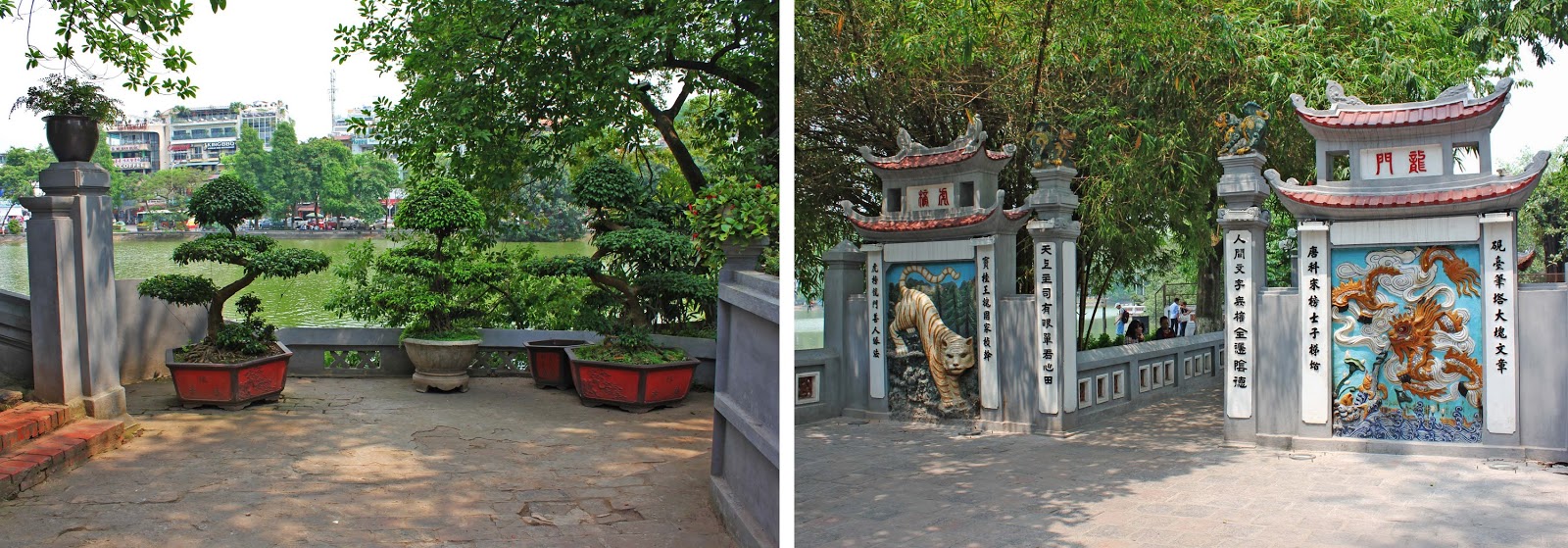

Examples of such courtyards with cay canh trees are shown in the images above and below.


The temple’s three most impressive cay canh trees are shown in the images below.


They are located on a platform housing the Pavilion Against Waves (Dinh Tran Ba). This pavilion can be seen in the very first set of images of this post. Below are more images showing the platform with the trees arranged on it.


Other cay canh trees in the temple were not as refined and images below show some examples.


Finally, one cannot talk about the Temple of the Jade Mountain and the Lake of the Returned Sword without mentioning the Turtle Tower (Thap Rua) located in the middle of the lake. Images below show this scenic landmark.


I don’t have to recommend a visit to the Lake of the Returned Sword here, because almost any tourist visiting Hanoi would end up somewhere around it. The Temple of the Jade Mountain is charming and worth having a look if you are already there.

Friday, September 16, 2016

Demonstration by Min Hsuan Lo


Another winter is over and it's time for another ‘Tops Weekend’, the annual event held in Sydney by the Illawarra Bonsai Society. You can see my blog posts about some of the previous guest demonstrators at 'The Tops' here: Marc Nöelanders, Robert Steven, Steve Tolley. This year’s guest demonstrator was Min Hsuan Lo from Taiwan. This wasn’t his “first rodeo” in Australia. A couple of years ago he demonstrated at the National Bonsai Convention in Perth. The feedback about him at that time was good and I was especially curious about his demonstration at the Tops. 

During the workshop on Saturday morning, I noticed that in some instances Lo made unorthodox decisions. This observation was confirmed during the Saturday night demonstration. The material Lo chose for the demo was a Juniper which was achingly suitable for an informal upright design (see images below). Previously, Marc Nöelanders and Mauro Stemberger worked with very similar material from the same source and produced almost identical informal upright results. I was bracing myself for another one just like it, when Lo told us that he hasn’t decided what style it’s going to be, but it not going to be informal upright.    

Lo explained his intention with a joke. He said that he feels like a school boy facing typically boring expectations from his farther and it would be almost common sense for the boy to defy such expectations and do the opposite. I think Lo wanted to do something unconventional to stimulate our “artistic muscles” and to show the audience the world of artistic freedom where “left-back-and-right-makes-informal-upright” stereotype is just a small piece of a puzzle. You can see the final result of the demonstration in the right hand image below. It is not influenced by the Japanese conventions. There is potential for future elegance and balance in the design. It is unrefined and unfinished, but I could see the beginning of a tree with individuality and a degree of uniqueness.

In a week since “The Tops” I heard a rumour that “some people didn’t get him”.  Lo spoke with a heavy accent and I could see the audience struggling to understand him. I spent years working in Penang where everyone spoke Lo’s native dialect (Hokkien Chinese). Understanding him was "a walk in the park” for me. He was very relaxed, spent a third of his demonstration talking with lots of humour and at the end he produced something that got my attention. So, I like him.

Friday, January 23, 2015

Penjing Museum, Tiger Hill, Suzhou


Another post about my visit to Tiger Hill, which took place this time last year. One of the traditional buildings at the Tiger Hill Penjing Garden was a penjing museum. All information there was in Chinese, so I concentrated on examining antique containers displayed there. Images below show some of them.

Below is the legend to the images above:

A – Blue and white porcelain, size 41 x 27 x 15 cm, late Qing Dynasty (1644-1912).
B – Coarse clay container, size 37 x 55 x 18 cm, Ming (1368–1644) or early Qing Dynasty.
C – River clay container, 49 x 25 x 15 cm, mid Qing Dynasty.
D – Yuxing ‘purple sand’ ware with landscape painted in black pigment, size 48 x 32 x 18 cm, late Qing Dynasty.
E – No information, probably Yuxing ware, unusual form and decoration.
F – Yuxing ‘purple sand’ ware with painting and calligraphy, possibly by artist Lu Hui Li (1851-1920), size 24 x 24 x 36 cm.
G – Yellow clay container, probably Yuxing ware, size 18 x 15.8 cm, late Qing Dynasty.
H – Yuxing ‘purple sand’ ware, unusual bucket-shaped container, size 20 x 20 x 18.5 cm, mid Qing Dynasty (displayed as a photograph).
I – Container with ink painting style decoration, size 26.5 x 16.5 x 14 cm, mid Qing Dynasty (displayed as a photograph).

Apart from that, an antique penjing tool displayed there made me realize how basic the tools were in the olden days (see images below).


I don't visit penjing museums very often, so it was fun.

Tuesday, January 13, 2015

Tiger Hill Penjing Garden, Suzhou


Tiger Hill Penjing Garden is the best ‘bonsai garden’ I have seen to date and I have seen a few places in Japan, China, Singapore, Malaysia and Australia. Before saying anything about the garden one must appreciate that Tiger Hill and Suzhou are steeped in ancient history and culture. Historic references to it go back to ‘Spring and Autumn’ period (771-476 BC). For thousands of years Suzhou remained an important cultural centre, it became the “city of gardens” and the home of Suzhou school of penjing. Images below show some of the Tiger Hill surrounds.

All elements of Tiger Hill Penjing Garden form a cohesive whole. Buildings, walls, walkways and hundreds of penjing trees are all in harmony with each other. See it for yourself in the images below.

Most penjing trees were of a high standard, however it was very difficult to photograph them because they invariably had a busy backdrop behind them. Elms (Ulmus pumila, U. parvifolia) and Chinese Sweet Plum (Sageretia theezans) constituted the majority of deciduous trees in the garden. Images below will give you a representative sample.

A handful of broad-leaved trees had leaves on them and they are shown below. The one in the middle is Japanese Box (Buxus harlandii).

As for the conifers, junipers were almost exclusively Juniperus formosana and J. chinensis. All J. formosana trees had brownish foliage (see images below). Some of the trees were quite large. The image marked with asterisk shows a two-meter-tall tree.

Images below show some of the pines, which mostly were White Pine (Pinus parviflora) and Black Pine (Pinus thunbergii).

There was also a number of very high standard rock penjing shown in the images below.

Every moment in Tiger Hill Penjing Garden was simply precious.