Showing posts with label bonsai history. Show all posts

Sunday, June 09, 2019

My visit to Ha Long Bay


Bonsai often draws inspiration from traditional Chinese paintings, and many famous paintings of the Ming and Qing era are inspired by the weathered hills of Guilin in South China. These hills are karst or eroded limestone formations. I’ve never seen Guilin, but during my trip to Vietnam I got to see spectacular karst formations of Ha Long Bay. I felt that potted trees and miniature landscapes, omnipresent in Vietnam, draw a lot of inspiration from the natural wonder of Ha Long Bay.


A modern-day bonsai kōan


A Japanese friend once told me a modern-day bonsai kōan. Kōan is the Japanese word for a paradoxical anecdote or a riddle used by Zen masters to make their disciples understand something. So, here it is.

Once upon a time, during Japan’s economic boom, there was a corporation. Back in those days, companies supported employees’ recreational activities and this particular one sponsored an in-house bonsai club. The company hired a bonsai master to instruct the club members and his bonsai were displayed in the headquarters foyer. Every day, hundreds of people passed by the bonsai display, but hardly anyone took notice of it.

All good things come to an end and with the onset of economic depression the company began to cut costs. It gave the boot to the bonsai master, but asked the club to continue displaying bonsai in the foyer. The employees happily started showcasing their own work and suddenly everyone began noticing and talking about the bonsai in the foyer.  

Why do you think trees created by the bonsai master were not obvious, while bonsai trees by amateurs were conspicuous?

Friday, January 19, 2018

The Temple of Literature, Hanoi

The Temple of Literature is basically what is left of the Imperial Academy created to educate Vietnam’s elite in medieval times. This is where they held Vietnam’s civil service examinations and I can’t help thinking that it mirrored Chinese imperial examination system. This educational institution was dedicated to Confucius and a couple of sages and scholars and functioned from 1076 till 1779. I would say it had a pretty good run.

When I started writing this post it was difficult for me to figure out which photos have been taken in which part of the temple, so I ended up drawing a plan shown below to make the post more visual and somewhat structured.


Images below show the main gate of the temple. I am not an expert on traditional Vietnamese architecture, but it felt like there is something distinctly Vietnamese about it.


Since the temple is surrounded by walls and its courtyards are separated from each-other by walls as well, there are quite a few gates. They are all different and well-integrated with the surrounding gardens. The image below left shows the Dai Tai gate. It is one of the side gates located in the first courtyard. The image below centre shows a bit of the first courtyard and the gate leading to the second courtyard. Another gate is shown in the image below right. It is called the Khue Van pavilion and it provides a passage from the Second to the Third Courtyard.


The temple gardens feature a number of ponds. Images below show two examples. The image on the left shows one of the ponds in the First Courtyard and the image on the right shows the Thien Quang well in the Third Courtyard.


Below are images of the Fourth Courtyard featuring trees growing in large concrete planters.


The focal point of the whole complex is the main hall of the temple located in the Fifth Courtyard. Below are images showing some of its features. The rightmost image shows the altar to Confucius.


Finally, let’s make this post relevant to the topic of bonsai. Below are some examples of potted trees photographed in various areas of the temple.


Images below show larger potted trees located in the Fourth Courtyard.


What can I say about the potted trees in the temple? They all display some degree of styling. None of them are terribly refined, but given the context, they probably don’t have to be. To me they provide historical context for bonsai by linking Oriental style potted plants with penjing.

Overall, the Temple of Literature was a great place to visit. It taught me that cultivation of styled potted plants was an important scholarly activity in Vietnam.

Saturday, July 08, 2017

The Temple of the Jade Mountain, Hanoi

Last year, I visited the Temple of the Jade Mountain located on Jade Island near the northern shore of the Lake of the Returned Sword (Ho Hoan Kiem) in Hanoi. Image below shows the island with the temple lit up at night. The lake has this epic name that come from a legend. I am not going to repeat Wikipedia here, but it’s basically a Vietnamese version of the Excalibur story and the bottom line is “If you have been given a magic sword, one day you need to give it back”. Just like in real life good things don’t last and that is what makes them “magic”. In the legend, the sword is returned to the Golden Turtle God which is shown in the image below left. The belief in this deity was inspired by the presence of a large species of soft-shell turtle (Rafetus swinhoei) in the lake. It is believed to be locally extinct and the last known individual was found dead just four months before my visit.


The temple dates back to the 18th century and is dedicated to several historical figures. Among them a couple of scholars, but my favorite is general Tran Hung Dao who repelled three Mongol invasions during Kublai Khan’s rule in the 13th-century.

The temple has several architectural landmarks. The image below left shows the gate with a large ink-slab placed on top of it (Dai Nghien). The center image shows the Welcoming Morning Sunlight Bridge (Cau The Huc) connecting Jade Island with the mainland. The image below right shows the Moon Contemplation Pavilion (Dac Nguyet).


I understand that it’s a Taoist and Confucian temple. The main temple building shown in the images below was antique and quaint as opposed to freshly painted buildings in the images above. 


Some of the temple furniture was impressive. The door panels were beautifully carved (images below). Statues of the temple deities looked interesting too. There was also something different about the main incense burner, probably the handles featuring horned qilin heads and the feet featuring lion heads (centre image below).


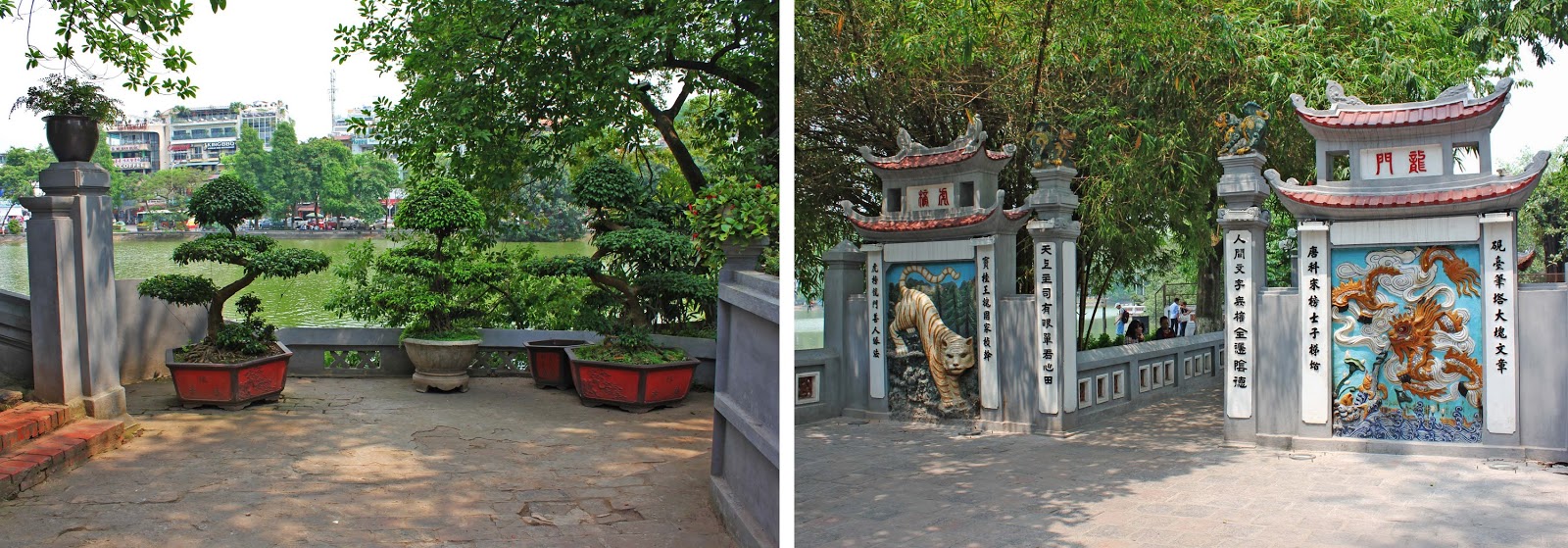
My visit to Vietnam had nothing to do with my interest in bonsai, but bonsai was there for me to find it. Buildings, hedges and parapets in the temple grounds form many secluded areas decorated with many cay canh trees. Typically, they were large size, styled trees grown in decorated concrete containers.


Examples of such courtyards with cay canh trees are shown in the images above and below.


The temple’s three most impressive cay canh trees are shown in the images below.


They are located on a platform housing the Pavilion Against Waves (Dinh Tran Ba). This pavilion can be seen in the very first set of images of this post. Below are more images showing the platform with the trees arranged on it.


Other cay canh trees in the temple were not as refined and images below show some examples.


Finally, one cannot talk about the Temple of the Jade Mountain and the Lake of the Returned Sword without mentioning the Turtle Tower (Thap Rua) located in the middle of the lake. Images below show this scenic landmark.


I don’t have to recommend a visit to the Lake of the Returned Sword here, because almost any tourist visiting Hanoi would end up somewhere around it. The Temple of the Jade Mountain is charming and worth having a look if you are already there.

Saturday, June 10, 2017

Origins of Nanban pottery: Hội An, Vietnam

I was aware of Namban pottery for a long time, but since my trip to Japan in 2015 this interest became deeper. This fascination arose from the fact that Namban’s origins are shrouded in mystery and I am a person who likes to get to the bottom of things. The best explanation of Namban origins I found so far is here http://lomov.blogspot.com.au/2015/09/namban-bonsai-pots.html.

South-East Asia has always been a suspect provenance of Namban pottery and last year, I made a Namban discovery of my own, while traveling in Vietnam. During a visit to the Museum of Folk Culture in Hội An, I came across of a ceramic piece that simply “screamed” Namban at me (see image below left). For comparison, the image below right is a contemporary piece of similar shape and size made by a renowned Japanese potter Yukizyou Nakano also known as “Gyozan”.


I learned at the museum that the pot has been made in the Thanh Hà village near Hội An. Potters of Thanh Hà village have been making functional low-fired unglazed pottery since the beginning of the 17th century. Nguyen Dynasty records of the time tell us that their wares have been transported by river to the nearby commercial port of Hoi An and from there exported to the coastal provinces of Central Vietnam and abroad. All this got me thinking and I realised that six historical occurrences took place at the same time, all of them at the beginning of the 17th century. Here they are:

1. Potters settle in Thanh Hà village near Hội An in Vietnam.
2. Hội An becomes the most important trade port in the East Vietnam Sea.
3. Tokugawa Ieyasu issues permits to Japanese merchants to trade with Vietnam.
4. A thriving Japanese trading settlement springs up in Hội An.
5. Increasing demand for rustic and unassuming ceramics for tea ceremony in Japan.
6. Earliest Namban pottery appears in Japan.

When the facts line up like that, Vietnamese provenance of some of the early Namban ceramics becomes quite plausible. I could also add here that the oldest extant Vietnamese ceramics have been found in Japan, in a tomb at Dazaifu and they date back to 1330. Vietnamese ceramics made in the 15th and 16th centuries also have been found in Okinawa, Nagasaki, Hakata, Osaka, Sakai and Hiroshima.

One architectural remainder of the former Japanese presence in Hội An is the Japanese Bridge. At the beginning of the 17th century Japanese merchants in Hội An were influential enough to build this bridge across the river to trade with the local residents (see the images below).


As a more general afterthought, I would like to finish this post with a photo of a lidded jar I saw in Vietnam and I hope you see the connection with the topic of this post. Lids of such jars were converted into bonsai containers known today as Namban.


Sunday, June 12, 2016

Reference to a hut-style teahouse in Ming China


Teahouse architecture is a recurring theme in my blog and all those posts have been about teahouses in Japan. I’ve never came across of a reference to a ‘teahouse’ in China in its Japanese sense, a rustic free-standing hut. Not anymore. I am reading a book by Craig Clunas about connoisseurship in Ming China. One of his primary sources is a text titled "Treatise on Superfluous Things" written around 1620 by a scholar, painter and garden designer from Suzhou Wen Zhen Heng. This book was a manual for people of means and taste. The first chapter of the book is titled ‘Studios and retreats’ and Clunas translated a small section of it pertaining to teahouses. It reads as follows:

Build a structure of column’s span, adjacent to a mountain studio, and set therein the tea utensils. Train a boy to the exclusive service of tea, so the whole day may be spent there in pure talk, the chilly night spent in sitting there in a dignified attitude. This is the first priority of the recluse, which cannot be dispensed with.
 
According to Clunas, Wen Zhen Heng’s treatise is heavily based on earlier work by two of his contemporaries. One of them is the dramatist Gao Lian who wrote “Eight Discourses on the Art of Living” and the other is Tu Long who wrote "Desultory Remarks on Furnishing the Abode of the Retired Scholar". Clunas tells us that the work of Wen Zhen Heng, Gao Lian and Tu Long is based on even earlier texts dating back to Song dynasty. This means that when Sen no Rikyū was pioneering soan style teahouses at the end of the 16th century in Japan, the practice of doing something very similar was already old in China. 

By the way, this topic has a connection to bonsai. Tu Long’s "Desultory Remarks" has an entire chapter on potted plants and Gao Lian’s “Eight Discourses” has chapters on plants and rocks.

The image above shows a Rikyū style teahouse called Kaho-an. It has been reconstructed at Happo-en garden in Tokyo and it dates back to Taisho period.

Monday, January 04, 2016

Asian section, The State Gallery of New South Wales


Today, I took my daughter to the State Gallery of New South Wales. I always enjoy visiting it, but this time the Asian section had a couple of things related to bonsai. The entrance of the section was marked by a large Chinese viewing stone from lake Taihu. I am used to seeing such stones in Chinese gardens, but seeing it in a sterile setting of a gallery surrounded by lots of negative space gave it a very contemporary air (see the image below).


Another exhibit that drew my attention was a beautiful flower bulb bowl. It was about 30 cm in diameter and even had couple of drainage holes (see images below). This simple, but elegant porcelain ware with a blueish celadon glaze was produced in Jingdezhen during Yongzheng period of Qing dynasty (1723-35).


I would like to finish this post with something not related to bonsai. Some 19th century Japanese tsubas. All inspired by nature (images below).

Tuesday, October 06, 2015

Kinkaku-ji and Rikusho-no-Matsu


During my recent bonsai residency in Osaka, I had only four days off and I used them to visit some temple gardens in Kansai area. One of them was Kinkaku-ji. Looking-up “the Golden Pavilion” on the Internet parades a long string of idyllic images like the one above left. The image above right however, shows the reality behind those “heavenly” shots. During my visit, the temple was crowded and noisy. Getting to one of the better look-out points required a combination of waiting in a queue and pushing through people.  

On a different topic, Kinkaku-ji has a small place in the bonsai lore. Its garden features a 600 year-old pine that goes by the name ‘Rikusho-no-Matsu’ (see the image below). The tree was originally a bonsai planted in the ground by shogun Ashikaga Yoshimitsu (1358 – 1408). The place was his house at that time and he was just planting a tree in the garden. These days, the tree is shaped as a sailing boat, which is reportedly heading to the "Western Pure Land of Ultimate Bliss". Let’s not get too excited, it’s only a tree.