Sunday, May 27, 2012

Bonsai display at Singapore Botanic Gardens


I visited Singapore Botanic Gardens with the sole purpose of seeing its bonsai display. The display pavilion is very nice and the trees are exhibited well (see image above). Smaller trees are displayed on the shelves inside the pavilion, while larger trees placed on individual stands outside the pavilion (see image below).


A few smaller trees are shown in the image below.


For a small sample of the larger trees see image below.


Although it was worth the visit, I couldn’t help noticing that the plants there could do with some extra love and attention.


For posts about bonsai gardens I visited in China see these:
Tiger Hill Penjing Garden, Suzhou: http://lomov.blogspot.com.au/2015/01/tiger-hill-penjing-garden-suzhou.html
Penjing Garden at Shanghai Botanic Gardens: http://lomov.blogspot.com.au/2014/12/penjing-garden-at-shanghai-botanic.html
Penjing Garden at the Humble Administrator’s Garden, Suzhou: http://lomov.blogspot.com.au/2015/01/penjing-garden-at-humble-administrators.html

Sunday, May 20, 2012

Penjing at Lian Shan Shuang Lin Monastery, Singapore


Last month, in Singapore, a friend-in-bonsai recommended to visit ‘Lian Shan Temple’. The taxi driver knew the place and told me that in the olden days the area was a crime district and the temple served as headquarters for triads and secret societies. Those days a long gone, but martial arts are still practiced in the temple. On my arrival, I found that its actual name is Lian Shan Shuang Lin Monastery and these days it is lost in a sea of high-rise apartment buildings. However, entering the monastery grounds is like stepping back in time. Elaborately decorated buildings adorned with carefully trained trees (see images below).
  
Have a closer look at some of those trees in the images below.

Garden trees were complimented by gorgeous rocks, some of which were petrified wood (see images below).

Check out images below. Image on the left shows a large rock used as a container for growing water lilies, while image on the right shows a rock used as a seat.

The monastery was also generously sprinkled with all sorts of potted plants. They were in open spaces, courtyards and passageways (see below).

Some of the potted plants were as large as the plants in the garden (images below).

Some of the potted trees looked grand, but large pots carved out of single pieces of granite were as impressive (see images below).

Finally, in one of the passageways I found penjing trees shaped as Chinese characters (see images below).

Wednesday, May 16, 2012

Pest of the month: The Mango Plant Hopper


This summer my back yard had been invaded by another plant pest. This time it’s the Mango Plant Hopper (Colgariodes acuminate). The Mango Plant Hopper is an introduced species and it resembles a lot of other plant hoppers belonging to the family Flatidae. It can be easily confused with another exotic pest the Citrus Plant Hopper (Colgar peracutum) or with native plant hoppers from genus Siphanta among others. Although my garden was full of them I couldn’t see any damage caused by them. Plant hoppers use their piercing mouth parts to puncture the plant and feed on its nutrients. May be they fed on lignified stems where puncture marks are not obvious or may be my bonsai trees are not their host plants. 
 

Monday, May 07, 2012

Cheng Tai Nursery, Singapore


During my trip to Singapore this month I visited Cheng Tai Nursery. It functions as a regular plant nursery where you can get your usual plants, but it also specialises in oriental style garden trees, penjing and bonsai. They have thousands of them and some are very impressive specimens. The average size of the trees was larger than I am used to. As you can see from the images in this entry a lot of the trees are taller than 1 meter. Anyway, I’ll let the pictures talk. A couple of images below are the largest oriental style garden trees in the nursery.


Images below show three main kinds of plants they use for large trees. They are (left to right): Wrightia, Podocarpus and pine.


There were also lots of large fig trees (image below).


Below more figs. They were very impressive.


I can confidently say that the king of bonsai in Singapore is Water Jasmine (Wrightia religiosa). See the images below.


Wrightia trees looked as impressive when they are defoliated. See images below.


Other large bonsai included something that looked like Casuarina.


There were trees of other plant species in the large bonsai category (images below).


And finally, they had plenty of smaller trees, which would come under small to medium bonsai size in Australia. As you can see from the close-up images of those trees (see images below), they have undergone quite a bit of training and refinement.


There were also a few larger ‘Chinese scholar rocks’ or ‘viewing stones’ for sale (see images below).


In one of the sheds at the nursery, I saw an elderly Chinese gentleman wiring a Podocarpus tree. I tried to start a conversation, but he couldn’t speak English. In a desperate attempt I tried to speak Malay and it paid off. I asked him how many people style bonsai trees at the nursery, because there were thousands of them. He said he is the only one. Even though all mundane tasks at the nursery are done by the Bangladeshi workers and he only styles the trees, it still remains a gargantuan amount of work. When he saw that I am genuinely interested in his work he took me to the back of the shed to show his personal collection. It was a lovely assortment of fairly refined shohin bonsai (see images below). Later on I was told that this gentleman is a well-known and respected figure in the local bonsai community.


To get to Cheng Tai Nursery take the train to Choa Chu Kang station and then get bus no. 975. There is a bus interchange right outside the station, but you need to take a 1 min walk to Choa Chu Kang Avenue 4, cross it and catch the bus over there. The bus stop where you get off is called Cheng Tai Nursery and you have to travel for about 4 or 5 stops.

Monday, April 16, 2012

More of bonsai in Chennai

Last year, during my trip to India I was lucky to get a glimpse of the Chennai bonsai scene. I attended a monthly meeting of Bodhi Bonsai Association and saw bonsai collections of two club members.
I am back to India this moth and just attended another meeting of Bodhi Bonsai. It was good to be with this group again. It is the only bonsai club in a city of 20 million and their membership is growing steadily. This time another club member invited me to see his bonsai collection (images above and below). I was overwhelmed by a variety of tropical plants. Just like last time I was impressed by fig trees, but this collection also featured impressive Adeniums and Jades among many others (images blow).

Wednesday, April 04, 2012

Pest of the month: The Punctate Flower Chafer

For the past three years the soil of my bonsai trees have been getting infested with curl grubs. The worst case was a round pot with inner dimensions 4 X 20 cm, which had 24 of these bad boys (photo on the left). I reared some of them to find out what they are. They turned out to be the Punctate Flower Chafer Neorrhina punctatum, family Scarabaeidae (photo on the right). I was fighting them by repotting my plants, because even submerging the whole pot in insecticide solution doesn’t always kill them.

Saturday, March 03, 2012

Pest of the month: Cuban Laurel Thrips

Some of my fig trees have a problem. Every new leaf they have gets red dots and curls-up (Fig. A). On close examination of the foliage I noticed small black insects (Fig. B), which tend to hide inside curled leaves. After examining these insects under the microscope they turned out to be Cuban Laurel Thrips Gynaikothrips ficorum (Fig. C, D). In Australia this species causes leaf roll on Ficus microcarpa and F. retusa, however when infestations get out of hand it can infect other figs such as F. benjamina and even Citrus species.
I control them by cutting off all the curled leaves, putting them in a plastic bag and placing the bag in the freezer for a couple of days, but this is only half of the job. Right after that, I spray the plants with a systemic insecticide. Insecticide spray doesn’t kill thrips hiding inside curled leaves and this is why they have to be removed and frozen.

Friday, March 02, 2012

This year's pots

I haven’t made many pots since my return from India last year, but I am slowly warming up to the idea. The green glaze stoneware round pot (250×65 mm) shown above was inspired by the traditional form of South Indian terracotta flower pots shown above as well. I made it for a bonsai friend in India.

Two pots in the photos below have white glazes on them, but not all turned white. The top pot in the image below is round (185×60 mm). Its white glaze produced interesting streaks of brown. The bottom pot is oval (280×215×45 mm). Its clay had such high iron oxide content that took all the whiteness out of the white glaze.

Saturday, December 31, 2011

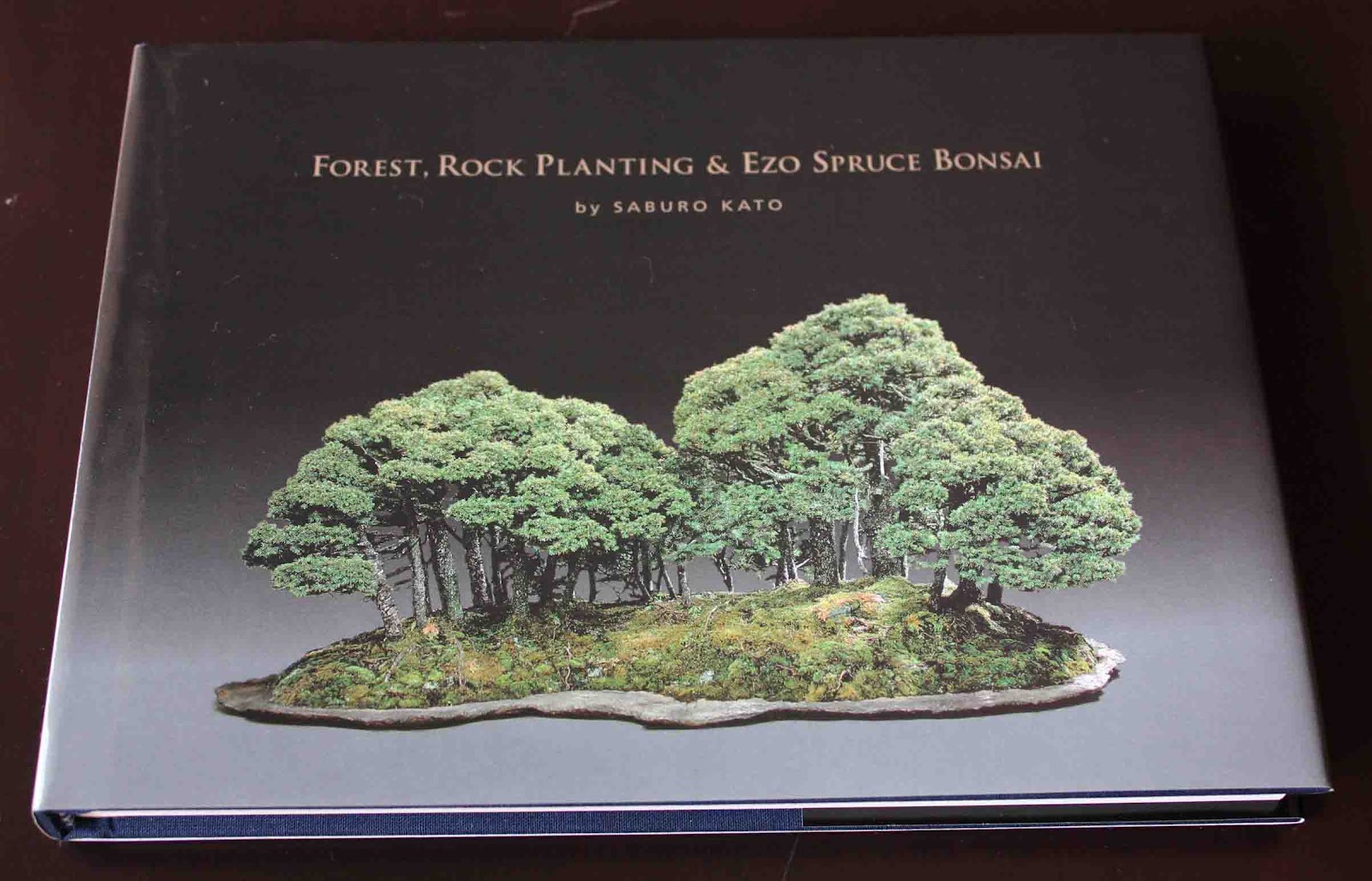
Saihate-no-oka by Saburo Kato


After my last year’s trip to Japan, I posted a blog entry titled “Forest planting by Saburo Kato?” (http://lomov.blogspot.com/2010/05/forest-planting-by-saburo-kato_7825.html). This forest setting was superb (see photo above), it was located in Mansei-en nursery in Omiya and I suggested that it was probably done by Saburo Kato. I wasn’t sure, but not anymore.

After reading Saburo Kato’s book ‘Forest, rock planting and Ezo Spruce bonsai’ I know that my guess was correct. In fact, the photo of this forest setting taken in 1988 is featuring on the book cover itself (see photo below). I also learned that the setting is much more special than I thought. This bonsai is one of Saburo Kato’s most well-known masterpieces called Saihate no oka (The Remotest Hill). All trees are Ezo Spruce (Piciea glehnii) collected by Saburo Kato 70 years ago from Kunashir Island, which is not a part of Japan anymore. The main trunk is about 250 years old! Saburo Kato worked on this forest for three years. When I saw the setting I thought it is on the rock slab, but the book says it’s on a custom made ceramic slab made in Tokoname. I must admit though, this setting looked better in 1988.

Sunday, December 25, 2011

Plant choice for bonsai: Sentiment vs suitability


India is an ancient civilization and in the course of its long history many plants acquired deep cultural significance. Some of them are loved as food, some for their medicinal properties and some for their religious significance. In an individual this significance manifests as sentiments towards certain plants. To an Indian bonsai grower plant’s sentimental value often has a stronger appeal than its suitability for bonsai. A good outcome is possible only when sentiment and suitability coincide. Peepal Tree (Ficus religiosa) is a good example of that (top left picture). This tree is worshiped in temples, its seedlings grow on top of almost every builing in Chennai and it is a great tree for bonsai. In fact, bonsai trees which impressed me the most in Chennai were figs. Some of them are shown in photos above and below.

Saturday, December 17, 2011

Bonsai soil for Chennai climate

The soil used for bonsai in Chennai is very different from what we use in Australia. It is a mixture of red clay, sand and cow manure. Some growers add broken low-fired red brick for better drainage. The sand used in the mix is rather small grain, like the one used for mixing concrete. While we in Australia make our soil mix for drainage, they in India make their soil for water retention. The climate in Chennai can be very hot and dry. Never the less, bonsai growers in Chennai complain that their trees grow too fast! Needless to say, clay and manure provide their plants with ample nutrients. High temperatures all year round don’t allow the soil to be saturated with water for too long, especially in a shallow container. I also think that native plants of Tamil Nadu are adapted to waterlogged soil during monsoon and very dry soil in summer. The soil is too sticky when wet and for repotting they use dry soil mix (see image below).

Bonsai containers in Chennai, India

It seems that in India there is only one ceramic artist who makes bonsai pots. His name is B.R. Pandit and his studio is at Bhayandar, Maharashtra. In the bonsai community his pots are referred to as ‘Pandit pots’. These pots demonstrate sound craftsmanship and mostly inspired by more ornate Chinese examples. Chinese aesthetics probably appeal to the artist and bonsai growers due to cultural proximity to China. Some examples of Pandit pots are shown in the image below.


Another type of containers I saw used for bonsai is Jaipur Blue Pottery (see pictures below). They are low-fired pots made of white clay and decorated predominantly with cobalt and copper oxides. If someone made them in stoneware and added feet, they would make a beautiful native style of bonsai pots.


Most commonly bonsai and bonsai material are grown in terracotta pots. They are hand-made, unglazed, low-fired flower pots, which sometimes come as shallow planters without feet. They are very unpretentious and sometimes slightly crooked. Old terracotta pots develop a patina of dirt and algae and can look quite wabi sabi (see image below).


Of course, I should mention that a lot of bonsai in Chennai are grown in containers imported from China. Chennai, however, doesn’t have a shop where you can buy them. Bonsai pots are ordered from Bombay or Kerala and buyers have to bear the cost of brakeage during transportation. Apparently, they are transported on the roofs of passenger buses and the brakeage is quite high. As a result of all this, bonsai growers in Chennai have a limited choice of containers.

Tuesday, December 06, 2011

A go at saikei

Yesterday was my last bonsai class for this year. The structure of the class was a surprise to all students. The class was divided into two teams and each team was given the same materials to create a saikei landscape. It was compulsory to use a ceramic mountain and nine small-leaved box plants and the rest was optional. The outcome of these efforts is shown below. Apparently, these two miniature landscapes will be auctioned later for charity.
   

Monday, November 14, 2011

Bonsai garden at Semmozhi Poonga park


Semmozhi Poonga is a paid entrance park in Chennai. It is run by the Tamil Nadu Directorate of Horticulture and Plantation Crops and it features a bonsai garden. Most of the trees are Ficus microcarpa imported from China. Among them there are trees in containers that are about five years old (see picture above) and trees planted in the ground which are about 40 years old (see picture below). The majority of the potted plants were in local unglazed terracotta containers without feet. I felt that this garden is that it’s bedraggled.

Saturday, November 12, 2011

Bharani jars from Kerala


Dakshinachitra is an open air museum of traditional South Indian architecture. Traditional houses displayed there also feature traditional household items. In a traditional Hindu house from the South Indian state of Kerala I saw interesting earthenware jars. Unlike the unglazed Indian terracotta ware used for cooking, these jars were glazed earthenware (see the picture). Later, I learned that in Kerala these jars are called Cheena Bharani because they were originally made in China for transporting preserved foods. Bharani jars would regularly end up in Kerala through maritime trade, where they were used for preparation and storage of Indian style pickles. To me, these jars emanate what Japanese call wabi. It was interesting to see three different traditional glazes and a very unintentional partial glazing used on the leftmost jar.