Wednesday, May 22, 2013

Bonsai in ten months

I hardly ever blog about bonsai I have done myself. In this post, I would like to talk about this particular Small-leaved Privet (Ligustrum sinense). What you see in the leftmost image was accomplished in ten months.


Although this tree requires further refinement, its basic shape is already in place. This plant was pulled out of the ground and given to me for free in August 2010. It was approximately 50 cm tall, with no fine roots and no leaves. During the following year I allowed one branch to grow freely to be the future upper trunk and kept all other brunches shorter. There was no styling of any sort at that stage. In October 2011, I chopped the trunk and wired two lowest brunches (see the trunk chop scar in the centre image). In the following months, I gradually wired the rest of the branches and pruned them to form the foliage pads. By August 2012 this tree looked pretty much as it looks in the images. So, the actual implementation of the basic design took only 10 months (Oct 2011 - Aug 2012). The tree was planted in the current training bonsai pot in March 2013 (left image). The height of the tree from apex to the rim of the pot is 17.5 cm. The rightmost image is not real. I used Photoshop to bring the pot into proportion with the tree. This is just to demonstrate the importance of planting your bonsai in a pot of appropriate size. In conclusion, the take home message here is: “For quick results use local weeds and make small trees”.

Sunday, May 19, 2013

Grafting pine on thick trunk

I wanted to learn how to graft small pine scions on a thick trunk. Last October, I grafted seven Radiata Pine scions on a 6-cm-thick trunk. By the end of November 2012 two of them had new shoots. By January 2013 all scions were alive and six out of seven had new shoots. I removed the plastic protecting the grafts from drying in mid-March this year. Unfortunately, the plant died last month because I chopped off the upper trunk. I wanted to direct all the plant’s energy into the grafted branches, but my plan turned out to be deadly to the plant. Yes, I know. What was I thinking?! Anyway, below are a few images showing this plant’s progress.


A – The rootstock plant after repotting in August 2012;
B – The plant on completion of grafting in early October 2012;
C – Close-up of the grafted scions on the day of grafting in October 2012;
D – Close-up of grafted branches with new shoots in mid-December 2012.

Here are a few things I learned from this experience:
  • Advice from bonsai practitioners and the Internet was useful;
  • Peeling bark off the trunk, before making incisions, was helpful;
  • A grafting chisel is better for making incisions in the trunk;
  • Aligning cambium was easier because on a thicker trunk it is a wider band, which can be recognised by its dark orange colour;  
  • Enclosing the whole area with clear plastic with some moist sphagnum moss worked really well;
  • Once the grafts have new shoots, the plant needs more sun;
  • Don’t do anything drastic to the plant for at least a year.

Saturday, May 18, 2013

Pest of the month: scale insects

Over the last two years I have been taking photos of scale insects parasitising my bonsai. Only this month, I became more certain about their identities. Unlike the Brown Soft Scale I talked about last month (see http://lomov.blogspot.com.au/2013/04/pest-of-month-brown-soft-scale.html) these species secrete wax, which formes a protective shell over their body.  All four species shown below are invasive pests introduced to Australia from various parts of the world. All four have a wide range of host plants. The size of these insects changes as they grow, but the bits of plants shown in the photos should provide you with a rough size scale. Anyway, here they are.


A – The Pink Wax Scale (Ceroplastes rubens) on Japanese Flowering Quince;
B – The Nigra Scale (Parasaissetia nigra) on Japanese Black Pine;
C – The Fly Speck Scale (Gymnaspis aechmeae) on Port Jackson Fig;
D – The Hemispherical Scale (Saissetia coffeae) on Japanese Box.

Wednesday, May 08, 2013

Pest of the month: 28-spotted Potato Ladybird


It’s common knowledge that ladybirds are beneficial for your garden. Most species are predators feeding on aphids. This time however, the uninvited guest on one of my bonsai was the 28-spotted Potato Ladybird (Epilachna vigintioctopunctata), which happens to be an exotic herbivorous pest (images above show adult and larval beetles). This insect was once happily confined to its native range in the far eastern Russia. The introduction of potato from America triggered its spread to China, Japan and more recently to Australia and New Zealand. Adults and larvae of this beetle feed on leaves of many different species of plants. So, next time you see this ladybird in your garden, remember that it can be harmful.

Tuesday, April 23, 2013

Pest of the month: Brown Soft Scale


I recently found a new pest on one of my Ficus microcarpa bonsai. This time it was a scale incest. In the lab at work, I identified it as the Brown Soft Scale (Coccus hesperidum) (see images above). This is a common cosmopolitan pest which attacks many plant species used for bonsai. Figs, citrus, stone fruit trees, apples, quince and even orchids are just a few of them. Unlike other kinds of scale insect, soft scales don’t secrete wax, and they retain their legs, antennae and eyes throughout their life. You can’t see those body parts with a naked eye, but they are there (see the arrows pointing at eyes). Adult females are wingless and sedentary. Adult males are either winged or wingless and look similar to aphids. Control of Brown Soft Scale infestations is tricky. The infestation in my garden was small and I removed all scales with my fingers. When there are too many scale insects, you have to spray the plant thoroughly with a systemic pesticide or with one of those pest oils, but be careful  because these chemicals can injure the plant. Some of my bonsai lost leaves and even secondary branches. So, make the pesticide solution weaker than specified on the label and spray twice two weeks apart. Personally, I prefer one of the systemic pesticides, but other bonsai practitioners believe that an oil spray is more effective as it smothers the scales and they suffocate. 

Saturday, February 16, 2013

Yakshagana performance in Sydney


This post continues my blog’s ‘Asian performing arts theme’. I do it in a 'bonsai blog' just because I want to. I love traditional Indian theatre with my absolute favourite being Kathakali. While living in South India I got to see it only once. So, when I found that a similar south Indian dance-drama called Yakshagana will be performed in Sydney, I felt lucky. Yakshagana is less stylised and more folksy than Kathakali, which makes it is easier to understand for an outsider. Apparently, Yakshagana appeared as a distinct art form as early as the 15th century and currently exists in various styles across all south Indian states. This particular show was performed by Yakshagana Kendra theatre from Udupi, Karnataka. The performance consisted of two plays – ‘Jatayu Moksha’ a story from the epic Ramayana and ‘Nala Karkotaka’ a story from the epic Mahabharatha. All performers were of high calibre. The musicians were good. The singer, who in a way narrated the story, had an incredibly powerful voice. The costumes were stunning (see images below). The actor’s movements were precise and graceful, their acting was believable and poignant.  All this combined created an overwhelming feast for my eyes and ears.
  

Saturday, February 09, 2013

Pest of the month: snails and slugs


Some of the most annoying pests in my garden are snails and slugs. Sure enough they damage bonsai (seedlings, young shoots), but the most disappointing incidents relate to accent plants. Before an orchid is about to bloom, they would chew through the base of the inflorescence stalk. They would eat an entire pebble plant (Lithops sp.), and they would cause severe damage to my carnivorous plants (Sarracenia and Venus Flytrap). The culprits are two species the Common Garden Snail (Helix aspersa, image above left) and the Leopard Slug (Limax maximus, image above right). Both species were introduced to Australia from Europe. An interesting thing about the Leopard Slug is that a stretched body of a fully grown individual can be upto 20 cm long. Control of snails and slugs is very easy – snail pellets sold in most garden centers and hardware stores.
 
The Garden Snail is one of the edible species. It is ironic that superficially it is very similar to the endangered Cumberland Plain Land Snail (Meridolum corneovirens, image below right). The only place on this planet where you can find the Cumberland Plain Land Snail is western Sydney. Ironic again, you may find this rare snail under a pile of rubbish in your backyard (if you live in western Sydney). If you do, don’t worry - Cumberland Plain Land Snail doesn’t feed on living plants. To tell the pair apart see images below. The diameter of adult Garden Snail shell is 2.5 – 4 cm, while the diameter of adult Cumberland Plain Snail shell is 1.5 – 3 cm. The Garden Snail shell has a blotchier pattern and has fewer turns than Cumberland Plain Snail’s shell.

Friday, February 08, 2013

Not a pest of the month: praying mantises


This post is about a group of beneficial insects – the praying mantises. I occasionally see mantises on my bonsai trees, but last month I spotted immature mantises of two different species in a span of few days. They were the Garden Mantis (Orthodera ministralis image above left) and the False Garden Mantis (Pseudomantis albofimbriata image above right). I have photographed these species before and images below show how adult females of these two species look like (Garden Mantis is 4 cm long, False Garden Mantis is 6 cm long).

Praying mantises in your garden is good news for your bonsai. Bonsai are small plants, which makes them more vulnerable to attacks by herbivorous insects. In the invertebrate community of your garden, praying mantises are alpha predators standing at the top of the food chain. Their presence indicates a healthy and functional ecosystem. Mantises mostly prey on herbivorous insects, which means fewer herbivores damage your bonsai. Garden Mantis and False Garden Mantis are not the only mantis species I’ve seen in my backyard. Below are images of two other species I have seen in the past. The left image shows the Purple-winged Mantis (Tenodera australasiae) probably the largest species in Sydney area (adults 10 cm long). The right image shows a very small species Kongobatha diademata (2 cm long). 


Wednesday, October 31, 2012

More bonsai pots


Since I already started dribbling about bonsai pots in the previous post, I will continue on. I talked about bonsai pots I bought in Japan, but completely forgot about the pots I bought in Singapore last April. They are much more interesting (see images above). On the left is a Cultural Revolution pot made in Yixing Zisha Factory No. 1 between 1965 and 1975. During that period Yixing craftsmen were disallowed to sign their pots, hence my pot has no marks. It is handmade. Each foot, each side and each rim corner of this pot has subtle differences. At the same time it is very well made (I know it because I am a potter). The clay colour, as far as Yixing clays go, is not too bad and it has some dark patina on its feet and the rim. The dimensions of the pot are 32 20 10 cm. The top right image shows a small Canton pot (9 5.5 cm). The collector I got it from said that it was sold to him as a late Qing Dynasty pot (before 1912), but he reckons it was made in the 1920’s. I like this type of Canton ware more than the usual green. It is colourful, but somber.


Images below show a couple of round pots made by me. They came out of the electric kiln only last week. The left image shows a pot decorated with black underglaze and a copper mat glaze. Its dimensions are 20 7 cm. The right image shows a pot with the same glaze measuring 23.5 8 cm.

Sunday, October 28, 2012

Little pots from Kyoto

Until this month, I haven’t owned a single Japanese bonsai pot. So, this trip to Japan I was determined to fix that. After visiting two of Kyoto’s bonsai nurseries and a number of ceramic shops, I realised that Kyoto is not the best place in Japan to shop for bonsai pots, unless you are specifically after Kyoto ware pots (Kiyomizu yaki) used for small bonsai. I also had to make a mental adjustment when it came to prices. Japanese put high value on things made by hand. For me, the adjustment was easy. Being a potter, I can guess how many hours it took to make a pot. Once I divide the price by the number of hours, I could see that the hourly rate is quite reasonable. However, all these calculations don’t make handmade Japanese pots more affordable. Top left pot in the image below is a good example. It is a hand-formed and hand decorated pot by a Kyoto based potter Takao Koyo. The pot measures 10.4 × 8.2 × 3.3 cm and it cost me AU$145. As for the other small pots in the image, bottom left is a pot made in China to Japanese specifications (imported by Kinbon). I must admit that Chinese mass produced pots in Japan are of much higher quality than what we get in Australia. The pot on the right is by a Kyoto potter Syosai. It wasn't expensive, but I liked the glaze.

Both Takao Koyo and Syosai also make more traditional Kiyomizu yaki bonsai pots where white surface of the pot is decorated with thin line paintings. Those pots are usually more expensive and can cost anywhere between hundreds and thousands of dollars despite their small size.

Friday, October 26, 2012

The Raku Museum, Kyoto


The story of tile maker Chōjirō and tea master Rikyu was one of my inspirations to take up pottery. The word ‘raku’ is in the vocabulary of every potter and finally I was at the very place where it all started over 400 years ago – the Raku Museum (top left image). The home and the work shop of the Raku family are right next door just as they were in the 16th century. At the time of my visit the museum was holding a special exhibition titled ‘In praise of surfaces – Raku teabowls, iron kettles, lacquered tea caddies’ (top right image). Unfortunately photography wasn’t allowed in the museum. Their collection is awe inspiring. From the historical point of view the most interesting tea bowl in the exhibition was ‘Isarai’ by Tanaka Sōkei (1535-?). Tanaka Sōkei was the biological father of Raku Jōkei II who was adopted by Chōjirō I (d 1589). This tea bowl features the ‘Sōkei seal’ given by Toyotomi Hideyoshi, which gave Raku family its name. There was also tea bowl ‘Murasme’ by Chōjirō and ‘Kansetsu’ by Hon’ami Kōetsu (1558-1637). The tea bowl that I liked the most was by Raku Chōnyū (1714-1770). Its glazed body was light pink with black crackle, while its unglazed hip and foot were reddish black.
A couple of years ago I took a few photos of the early Raku ware in Tokyo National Museum (http://lomov.blogspot.com.au/2010/02/yesterday-i-went-to-tokyo-national.html). Flash photography was prohibited hence the photos are a bit fuzzy. Nevertheless, they are below: left – teabowl named ‘Amadera’ by Chōjirō, middle – teabowl named ‘Suehiro’ by Jōkei, right – lion shaped incense burner by Jōkei as well.

Tuesday, October 16, 2012

Ryōan-ji, Kyoto


Ryoan-ji was the last place of interest I visited in Kyoto. I have seen photographs of it, watched documentaries and read interpretations of its meaning. I thought that all this prior knowledge would act as a spoiler, but I was wrong. Ryoan-ji still blew me away. I just sat there and did what most people do – look at it in contemplation. The image above shows the kare-sansui (rock garden) of Ryoan-ji as you enter the garden-viewing side of Kuri (the main building). The kare-sansui is about five hundred years old and its original designer is unknown. Its design may have changed over the centuries as well. The image below shows how the rocks are positioned in relation to each other.
    

Images below show close-ups of each group of rocks. These images also show the wall surrounding the garden. Apparently, the wall is made of clay boiled in oil and the patterns on the wall are formed by the oil leaching out over a long period of time.


The kare-sansui was built for viewing from the Kuri – Ryoan-ji’s main building. Images below show the entrance to the Kuri (image below left) and its interior with beautifully painted shōji (dividing screens) (below middle). There is a tea house called Zaroku at the back of the Kuri. Its roja (tea garden) adjoins the Kuri and featues a famous tsukubai (water basin) (below right). The tsukubai has four characters inscribed on it which can be translated as “I only know what I need”.


The rest of the temple grounds are quite charming with graceful buildings, moss laden parkland and stone pathways (images below).


Another feature of the temple is a large pond called Kyoyochi (images below). It offers delightful views, which I am guessing are even more spectacular in autumn colour or during cherry blossom.


Visit to Ryoan-ji certainly was a strong finish for my short stay in Kyoto.

Monday, October 15, 2012

Tōdai-ji, Nara

It would seem silly to complain about a trip to Nara, the ancient capital of Japan full of UNESCO World Heritage sites. Nevertheless, I didn’t work out the way I planned. First of all, it is infested with annoying and sometimes scruffy looking deer (image below left). One of them ripped my bag and scattered my belongings all over the street.


I wanted to go to Nara to see Todai-ji and Toshodai-ji temples. Todai-ji was a natural choice as Nara’s main attraction, while Toshodai-ji interested me as a presumed birth place of bonsai in Japan (although there is hardly any evidence of that). After visiting Todai-ji, I abandoned my Toshodai-ji plans in favor of visiting Shosei-en bonsai nursery. Todai-ji was majestic. Image above right shows Todai-ji’s main attraction - the Great Buddha Hall. Image below left shows the Great Southern Gate, while image below right shows the gate to the Great Buddha Hall complex.


The temple had a lot happening that day. There were processions, performances and lots of worshipers (images below).
  

There were a couple of interesting accessories outside the Great Buddha Hall. One of them was a very fine joss stick urn with beautiful patina (below left). The other is a large and very ornate lantern (below center). I was especially intrigued by one image on the lantern, which bore a remarkable semblance to Hindu deity Krishna (below right).
  

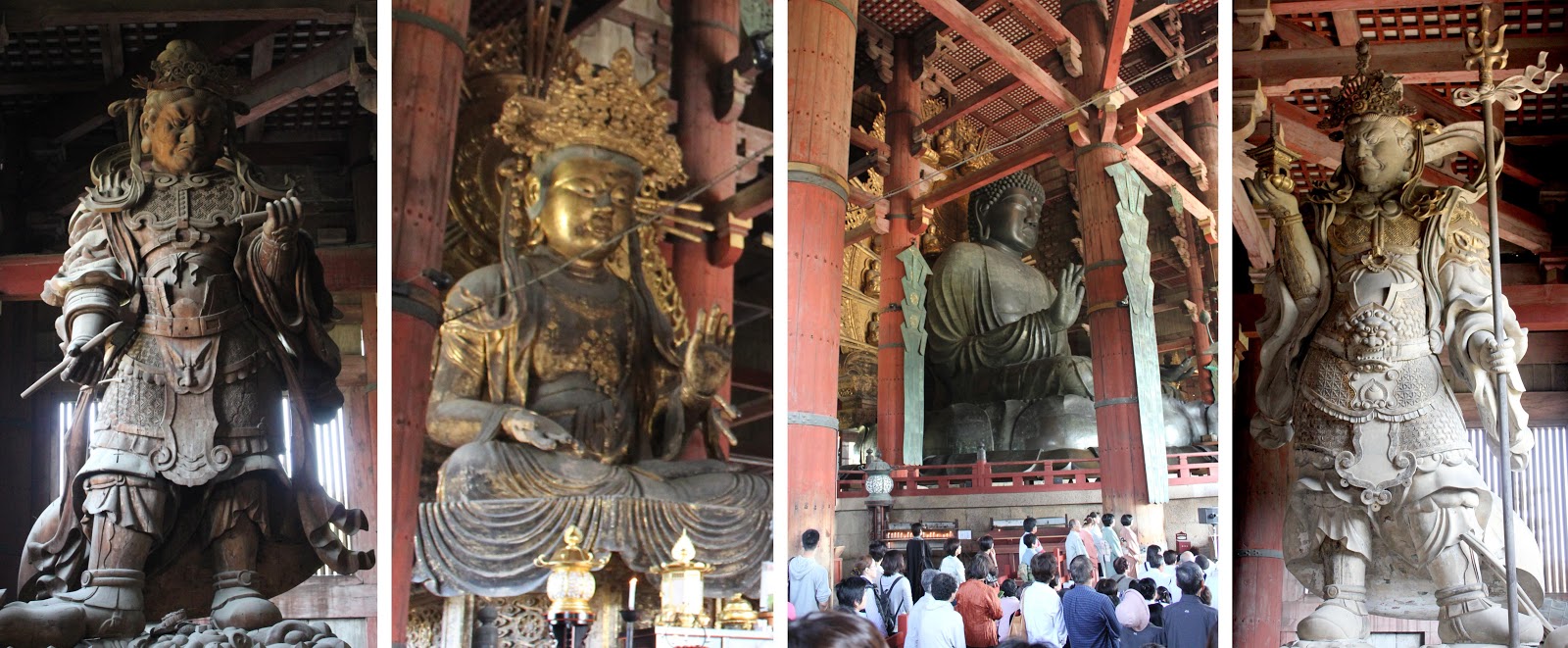
The Great Buddha Hall was as impressive inside. Images below show the giant idols housed inside it (left to right): Komoku-ten (Guardian of the West), Kannon (Goddess of Mercy), Daibutsu (the Great Buddha), Tamon-ten (Guardian of the North). All except Buddha are Hindu deities incorporated into Buddhism.


In retrospect, I wish I spent more time exploring Todai-ji grounds.

Shosei-en (bonsai nursery), Kyoto

Shosei-en was second of the two bonsai nurseries I visited in Kyoto. It should not be confused with the Shosei-en garden located in the vicinity of Kyoto Station. The nursery is tucked in a residential area and a bit tricky to find. However, it is only a ten minute walk from Misasagi Station (Tozai Line) and if you walked longer than that, you are probably lost. The entrance to the nursery is fairly nondescript with the exception of a small name board (image below left). Once you walk up to the gate at the end of a long driveway you can see the shelves with bonsai (image below right). At the time of my visit the nursery was minded by an elderly lady who I thick was one of the owners. My Japanese allowed me to have only a rudimentary conversation with her, so I just had a stroll around the nursery and took some photos.


Unlike Koju-en, Shosei-en is larger and specialises in medium to large trees. It did have few shohin bonsai however. Both coniferous and broadleaved trees were equally well represented (images below).


Among conifers pines were the most prominent trees and images below may give you an idea of their quality.


Conifers other than pines dotted the shelves of the nursery. Images below show Cryptomeria, Podocarpus and junipers.


Broadleaved trees were dominated by Japanese and Trident Maples. I couldn’t see the branch structure of the trees very well because they were in full leaf, but many of them had nice proportions and some featured fantastic surface roots (see images below).


Finally, few images of shohin trees are shown below. I thought some of them were quite good.


The choice of bonsai pots at Shosei-en was somewhat limited, but overall I had a good time there.


For posts about bonsai gardens I visited in China see these:
Tiger Hill Penjing Garden, Suzhou: http://lomov.blogspot.com.au/2015/01/tiger-hill-penjing-garden-suzhou.html
Penjing Garden at Shanghai Botanic Gardens: http://lomov.blogspot.com.au/2014/12/penjing-garden-at-shanghai-botanic.html
Penjing Garden at the Humble Administrator’s Garden, Suzhou: http://lomov.blogspot.com.au/2015/01/penjing-garden-at-humble-administrators.html